May 2026
Hydra - H2O Hackathon Water Intelligence Platform
H2O Hackathon - Hacking the Supply, May 2026
Flutter + FastAPI water intelligence platform built for the H2O Hackathon Hacking the Supply challenge.
Hydra is a hackathon-built water intelligence platform that combines a Flutter web interface with a FastAPI backend to explain California water supply conditions in simple, decision-ready language. Built for the H2O Hackathon Hacking the Supply coding challenge, the app uses the challenge's synthetic-but-realistic snowpack, precipitation, and reservoir data to help water managers, farmers, and concerned citizens understand water risk.
Real project asset
Hydra Water Outlook Platform
Hacking the Supply
Flutter Dashboard
FastAPI /api Backend
Three Water Signals
Highlight
Hacking the Supply
Highlight
Three Water Signals
Highlight
Flutter Web
Highlight
FastAPI Backend
Executive Summary
Hydra is a hackathon-built water intelligence platform that combines a Flutter web interface with a FastAPI backend to explain California water supply conditions in simple, decision-ready language. Built for the H2O Hackathon Hacking the Supply coding challenge, the app uses the challenge's synthetic-but-realistic snowpack, precipitation, and reservoir data to help water managers, farmers, and concerned citizens understand water risk.
Problem Statement
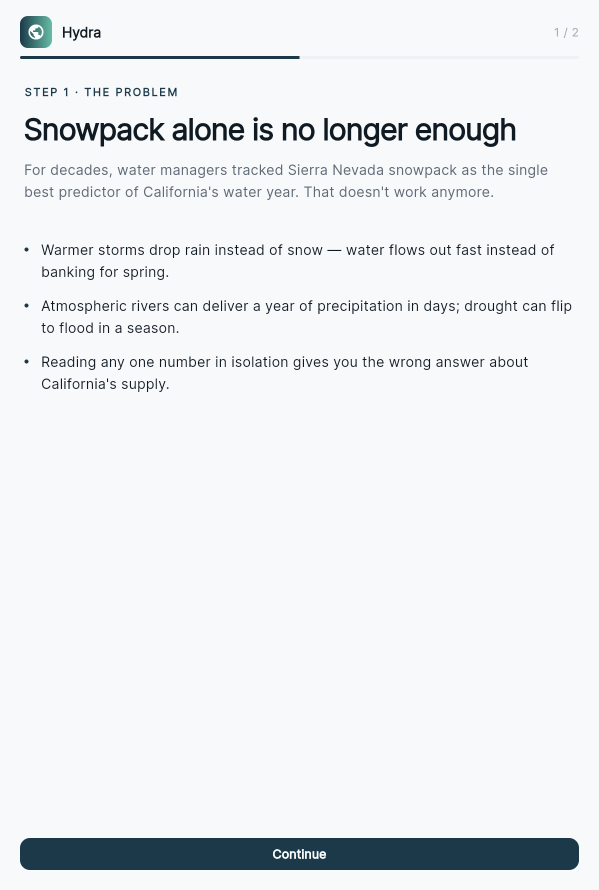
For decades, California water planning relied heavily on Sierra Nevada snowpack as a natural reservoir and annual supply signal. Warmer storms, earlier snowmelt, atmospheric rivers, and drought-to-flood volatility now make a single-signal approach less reliable. Hydra responds to the hackathon challenge by combining snowpack, precipitation, and reservoir storage into a clearer water outlook.
What I Built
Flutter web dashboard
FastAPI backend under /api
Water supply dashboard endpoint
AI assistant/chat endpoint
Hacking the Supply challenge data interpretation
Alert and outlook system
Swagger API documentation
Safety guard for AI summaries
How It Works
A conceptual workflow showing how the project moves from input to processing and output.
Step 1
Challenge JSON/CSV Data
Step 2
Snowpack + Precipitation + Reservoir Signals
Step 3
Deterministic Risk Classification
Step 4
Dashboard + Alerts
Step 5
Optional AI Explanation
Step 6
User-Facing Water Outlook
Architecture / System Design
A simplified system view of the major project components and how responsibilities connect.
Step 1
Flutter Web Frontend
Step 2
FastAPI Backend
Step 3
Supply Dashboard API
Step 4
Challenge Data Services
Step 5
Alerts / Forecast / Reports
Step 6
AI Assistant
Step 7
User-facing Water Outlook
Technical Implementation
Frontend
- Flutter
- Dart
- Riverpod state management
- Responsive dashboard UI
- Web deployment on Vercel
Backend
- FastAPI
- Python
- Pydantic schemas
- REST API endpoints
- Dashboard and chat routes
Challenge Data
- Synthetic-but-realistic H2O Hackathon dataset
- Snowpack percent of April 1 average
- Precipitation percent of average
- Reservoir percent capacity
- Multi-signal water outlook logic
AI Layer
- Groq API optional LLM integration
- AI-generated water outlook summaries
- Offline deterministic fallback
- Safety guard for source-number consistency
Testing / Deployment
- pytest backend suite
- 34 passing backend tests documented in README
- GitHub Actions backend tests
- Vercel Flutter web + FastAPI deployment
API Endpoints
Key deployed routes from the FastAPI backend mounted under /api on Vercel.
/api/healthChecks API status and reports LLM enablement.
/api/docsSwagger documentation for the deployed FastAPI backend.
/api/supply/dashboardReturns the combined water outlook, signal cards, alerts, and AI summary.
/api/supply/chatPowers Ask Hydra through the backend chat endpoint.
Screenshots & Visuals
Real project screenshots and outputs appear first. Where a project has no existing screenshots, the visuals are grounded diagrams or output previews based on the actual project structure.
Hydra Home / Onboarding
Real screenshot from the running Flutter web app introducing the hackathon challenge idea: snowpack alone is no longer enough.
Water Supply Dashboard
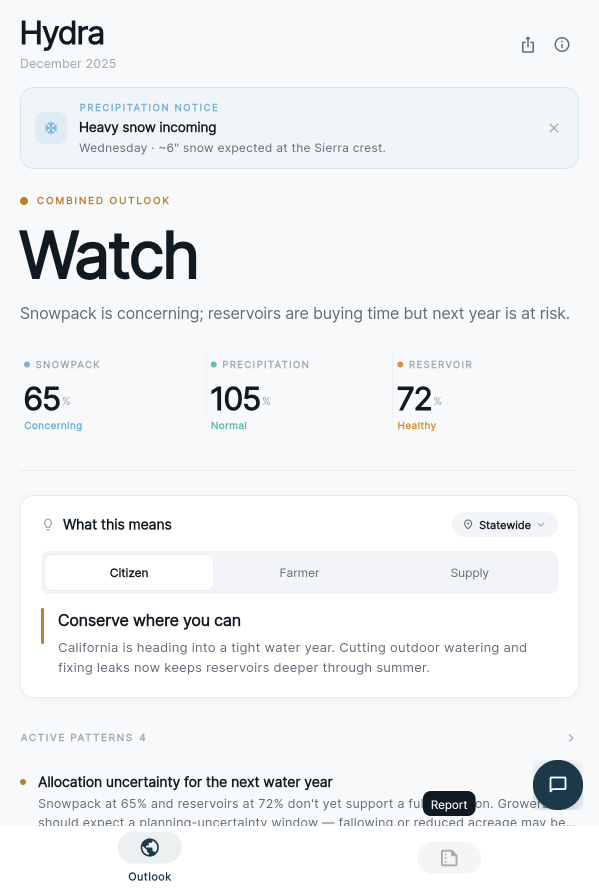
Real dashboard screenshot showing Hydra's Watch outlook and the three challenge signals: snowpack, precipitation, and reservoir storage.
Multi-Signal Alerts
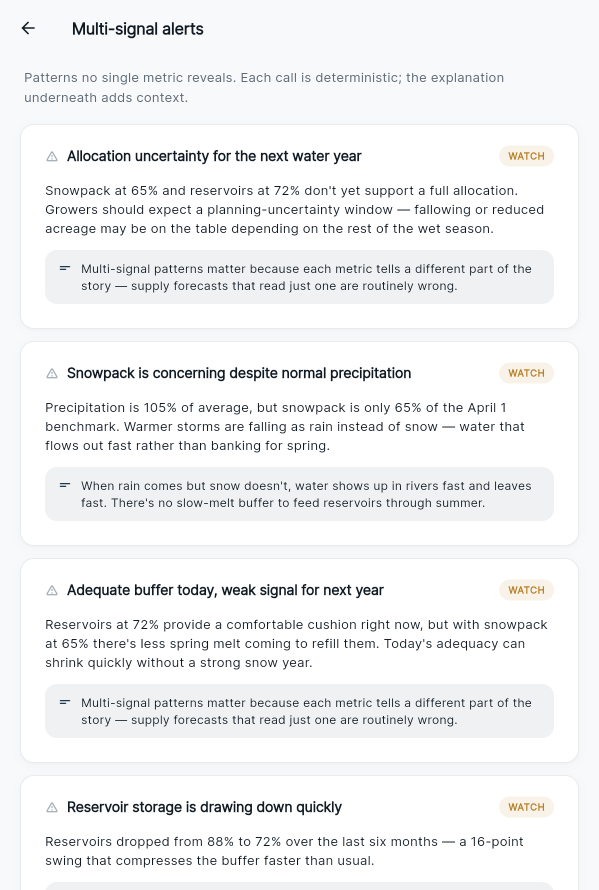
Real alerts screen showing how the app turns volatile water signals into warning-style guidance.
Trends Visualization
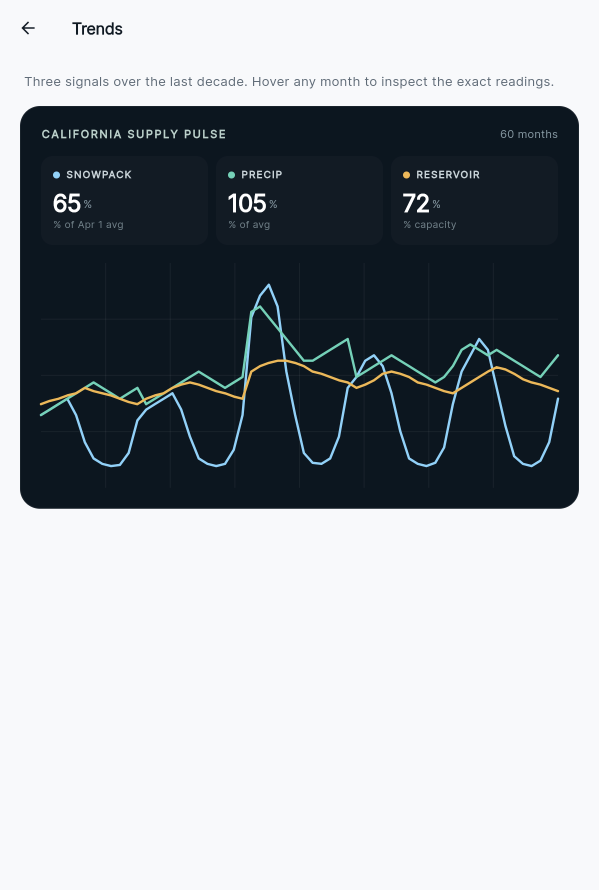
Real trends screen comparing snowpack, precipitation, and reservoir conditions from the challenge data.
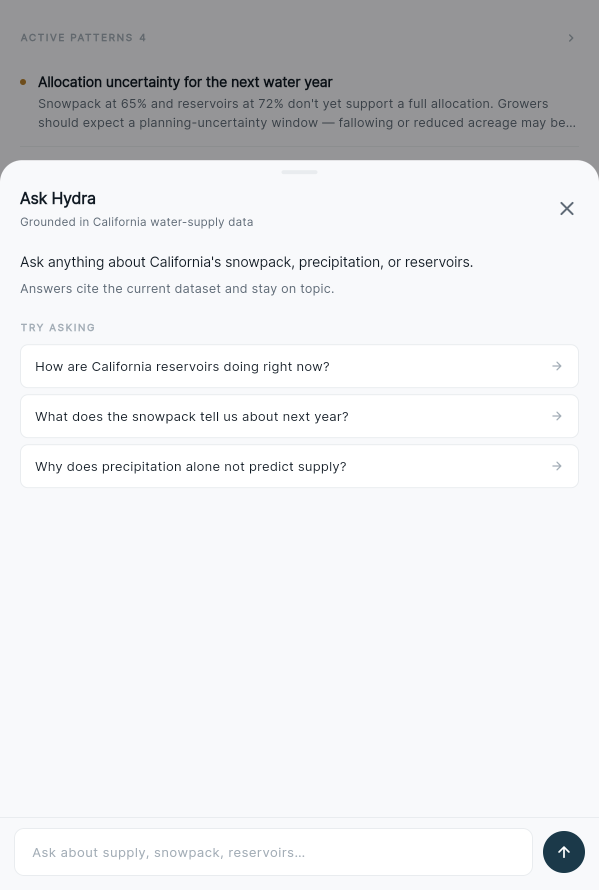
Ask Hydra
Real chat panel screenshot showing the AI-assisted water-supply explanation experience.
Key API Endpoints
GET  /api/health
GET  /api/docs
GET  /api/supply/dashboard
POST /api/supply/chat
Challenges & Solutions
Challenge
The challenge data combines different water signals with different meanings and thresholds.
Solution
Hydra separates snowpack as future water, precipitation as current conditions, and reservoirs as the supply buffer, then combines them into one water outlook.
Challenge
Water supply is volatile, and snowpack alone is no longer a reliable planning signal.
Solution
Hydra uses the Hacking the Supply framing to compare snowpack, precipitation, and reservoir storage together for a more complete picture.
Challenge
AI summaries can drift from source numbers.
Solution
Hydra includes a number-consistency drift guard that rejects AI output when percentages conflict with the source payload.
Challenge
Hackathon projects need fast deployment and clear demos.
Solution
Hydra uses Vercel deployment, FastAPI routes, Swagger docs, backend tests, and a Flutter web interface.
Results / Impact
Demonstrates practical full-stack engineering, API design, AI-assisted summarization, frontend dashboard design, and rapid hackathon delivery around a real-world environmental data problem.
Shows how deterministic water-supply logic and optional AI explanations can work together without letting the model own classification or alert decisions.